



|
|

Documenti
Legislazione
Direttive Sicurezza
Timeline Sicurezza IT
D.Lgs. 81/2008
Interpelli
Soggetti abilitati
ATECO / Livello rischio
Cassazione
Convenzioni ILO
TUSSL / Link


Documenti
Legislazione
Testo Unico Ambiente
Interpelli ambientali
Elenco CER
RENTRi


Documenti
Legislazione
CLP consolidato
REACH Consolidato
Seveso III
PXXX | EUH | HXXX
Elenco gas tossici
Parametri acque

Documenti
Legislazione
Norme armonizzate Click
Direttiva click
Nuovo approccio


Attività PI
D.P.R. 151/2011
Moduli PI
Codice RTO II
Norme PI 2022
Decreti PI Sett. 2021


Documenti
Legislazione
Tremcards
Etichette ADR
Kemler

Regolamento macchine
Direttiva macchine
Documenti Regolamento
Norme armonizzate
CEM4 | Software

HACCP (CE) 852/2004
MOCA (CE) 1935/2004
GMP (CE) 2023/2006
MOCA - GMP consolidato
Food Safety book

Documenti
Legislazione
DM. n. 37/2008
Legge n. 10/1991

Norme armonizzate
Direttiva click
Prassi di riferimento








| ID 14197 | | Visite: 3064 | Documenti Chemicals Enti | Permalink: https://www.certifico.com/id/14197 |
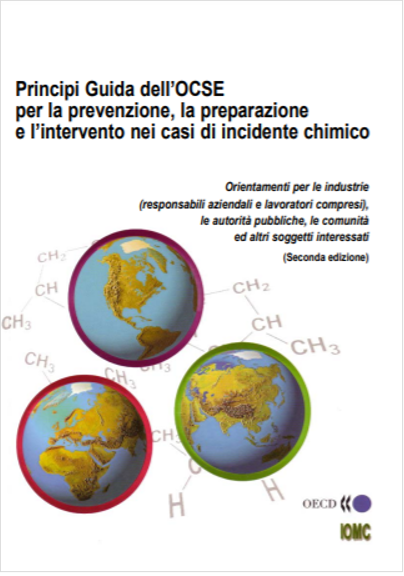
OCSE (Organizzazione per la cooperazione e lo sviluppo economico) / OECD
Orientamenti per le industrie (responsabili aziendali e lavoratori compresi), le autorità pubbliche, le comunità ed altri soggetti interessati
Questa seconda edizione dei Principi Guida dell’OCSE per la prevenzione la preparazione e l’intervento nei casi di incidente chimico è stata elaborata da un Gruppo di Estensori operante sotto gli auspici del Gruppo di Lavoro sugli Incidenti Chimici che cura il Programma OCSE sugli Incidenti Chimici. La formulazione di questi Principi Guida è stata intrapresa in cooperazione con altre organizzazioni internazionali operanti nell’ambito della prevenzione, preparazione e intervento nei casi di incidente chimico, tra cui l’Organizzazione Internazionale del Lavoro (ILO), l’Organizzazione Marittima Internazionale (IMO), la Commissione Economica per l’Europa delle NU (UNECE), il Programma delle NU per l’Ambiente (UNEP), l’Unità congiunta per l’Ambiente e gli Affari umanitari UNEP/OCHA (UNOCHA), e l’Organizzazione Mondiale della Sanità (WHO).
The Guiding Principles for Chemical Accident Prevention, Preparedness and Response address issues related to:
- preventing the occurrence of incidents involving hazardous substances;
- preparing for accidents, and mitigating adverse effects of accidents, through emergency planning, land-use planning, and communication with the public;
- responding to accidents that do occur in order to minimise the adverse consequences to health, the environment and property; and
- follow-up to accidents, including initial clean-up activities, and accident reporting and investigation.
These principles provide advice to public authorities, industry, employees and their representatives as well as members of the public potentially affected in the event of an accident, and non-governmental organisations.
The Guiding Principles apply to all hazardous installations, i.e. fixed plants or sites that produce, process, use, handle, store or dispose of hazardous substances where there is a risk of an accident involving the hazardous substance(s).
The Principles also apply to transfer facilities where hazardous substances are loaded and/or unloaded. The transportation of hazardous substances external to a hazardous installation (by pipelines, road, rail, sea or air) has not been addressed, although many of the Principles can be applied.
The Guiding Principles are based on the assumption that all hazardous installations should be expected to comply with the same safety objectives regardless of size, location or whether the installation is publicly or privately owned. They have been developed with the understanding that there must be flexibility on their application due to significant differences which exist among countries such as legal and regulatory infrastructures, culture, and resource availability. In addition there may be differences in approach in applying the Principles to new and to existing installations. The Guiding Principles apply to a wide range of industries and types and sizes of installations.
The Guiding Principles includes two addenda to the second edition of the Guiding Principles for Chemical Accident Prevention, Preparedness and Response:
The first addendum (published in 2011) takes into account the results of five workshops held under the auspices of the OECD Working Group on Chemical Accidents during the period from 2007–2003.
The second addendum (published in 2015) addresses Natural Hazards Triggering Technological Accidents (Natech) Risk Management; and consists of a number of amendments to the Guiding Principles and of the addition of a new Chapter providing more detailed guidance on Natech prevention, preparedness and response. It takes into account the results of the Workshop on Natural Hazards Triggering Technological Accidents (Natechs) Risk Management held in 2012, in Dresden, Germany that was held under the auspices of the OECD Working Group on Chemical Accidents (WGCA).
Collegati
| Descrizione | Livello | Dimensione | Downloads | |
|---|---|---|---|---|
 |
Guiding principles chemical accident OECD Addendum 2015.pdf OECD Addendum 2015 |
747 kB | 32 | |
|
Guiding principles chemical accident OECD Addendum 2011.pdf OECD Addendum 2011 |
788 kB | 5 | |
|
Principi Guida nei casi di incidente chimico OCSE 2005.pdf OCSE 2005 |
754 kB | 28 | |
|
Guiding principles chemical accident OECD 2003.pdf OECD 2003 |
1835 kB | 6 |
Tags: Chemicals Rischio Incidente Rilevante Abbonati Chemicals